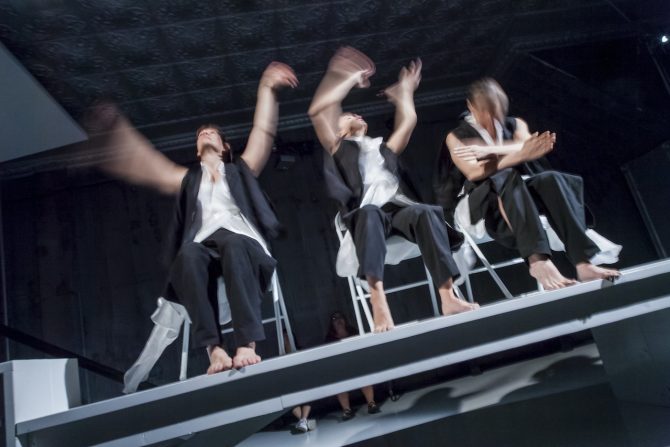
In her new three-hour “Allowances and Occurrences,” Zephyr artistic director Michelle Kranicke hopes for “an overlap, maybe even a struggle, between the performers and the audience.” Partnering withDefibrillator Gallery, she’s plopping down a huge plywood installation/set/bleacher, painted white, in the middle of an ambiguously designed space. “Who’s performing?” she says. “Who’s watching? I want people to sit on the set,” she adds, and generally roam the space at will, treating the four dancers, one live musician, and indeed the entire space as they would art in a gallery. She’s even serving wine, water, and coffee to facilitate taking breaks, and she hopes people will talk and come and go as they please.
A few years ago, Kranicke found that her “tried-and-true tools for discovering movement were becoming less satisfying. The frightening part was, I couldn’t figure out why. Was I less satisfied with the art form? Or was it because I was at a place where I was poised to take a new path?”
She’s concluded it’s the latter. Kranicke has always had a philosophical bent, and she moved from investigating the idea of mass in dance to “trying to find movement within stillness and to push to the edge what my definition of dance is, and what the public’s definition is — to open up that discussion. A lot of pop culture right now categorizes dance: this is contemporary, this is modern, this is lyrical, this is ballet. But it’s not so easily defined.”
She herself, Zephyr members Andrea Cerniglia and Colleen Welch, and guest artist Ayako Kato “spent all fall of 2011 basically being still. It was a physical challenge that moved into a mental challenge — you have to build a capacity to manage certain elements. What if you have to swallow? What if your eyes start watering? Slowing down, people found that their breathing was becoming much more shallow — and then you find yourself at a loss for breath. You have to stay awake — which is definitely easier with an audience there! But then it’s hard not to go fast.” She’s chosen to run the show two weekends partly “to allow the performers to sink into what it means to do a three-hour dance.”
To encourage “cross-pollination,” Kranicke built “a team of artists,” each contributing equally. Architect David Sundry (Kranicke’s husband), who created the installation/seating, told her how her choreography could serve his architecture. Violinist-cellist-accordion player Ronnie Kuller will roam the space, playing her original compositions. Amanda Lee Franck designed not only the costumes but the mesh-screen curtains that drape Defibrillator’s window wells, partly obscuring Kato’s solo. Rosa Gaia Saunders provides both recorded and live-feed video.
In fact the logistics of the operation proved so daunting that Kranicke drew up a timeline on tracing paper, which enabled her to place a map of each section of the dance, one at a time, over an architectural rendering of the space. The sections have nicknames. There’s a “rhythm section,” a “preposition dance” (Kranicke says, “I was trying to move way, way abstract”), and the humorous “otter section.” (“Is it still dance if I take away the ability to use your arms and legs?”) Even the “stillness” dance, which places strict limits on the dancers’ movement, is mesmerizing.
Kranicke knows that asking audience members to move around at will, even treading on the performers’ sacred ground, is a risk. “I’ve had to get up and move during a performance,” she says, “ and I’ve been a little crabby about it. ‘Oh, you want me to move? It’s Friday, I’m tired!’ We’ve been so trained to sit in a dark theater, not talk, look at the stage, not move. It’s a passive experience — which is one reason we like it!” Still, she believes that giving agency to the viewer will encourage his/her creative input. And she believes Defibrillator is drawing that kind of active viewer.
Kranicke knows that what she’s doing harks back to the early 60s and the Judson Church movement—“but I think that there are still some roads there worth exploring.” As for her title, she says, “Different things are occurring in the space, and we’re allowing all of it to be dance, whether it’s you moving, me moving, Ronnie moving, the lights moving, or the tissue paper moving. The definition of dance can be broad. The only thing making it narrow is us, by putting limitations on it.”